
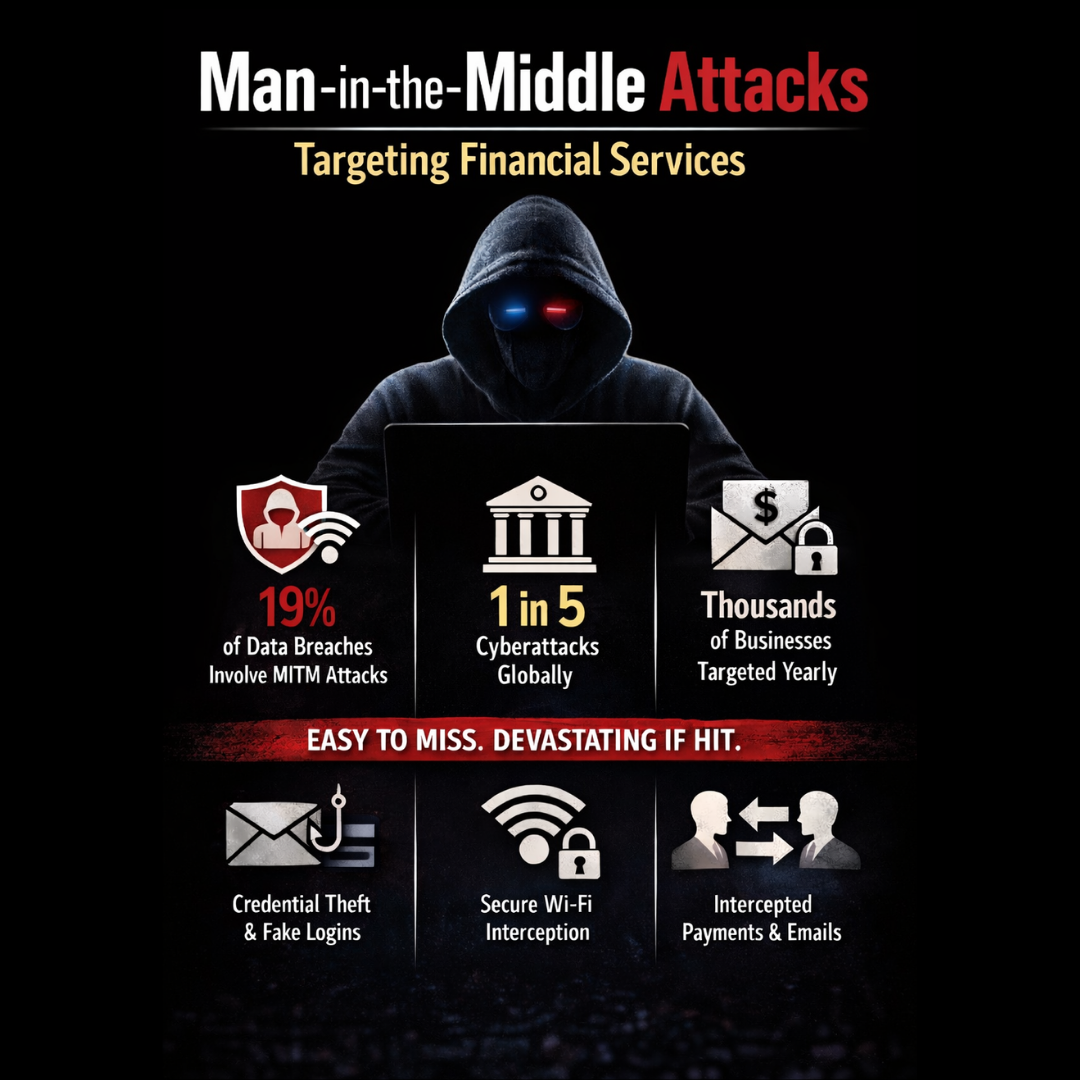
Man-in-the-Middle Attacks: How Financial Services Are Being Silently Hijacked
Financial services organizations invest heavily in cybersecurity, yet one of the most dangerous attacks requires no malware, no hacking skills, and often no alerts at all. It’s called a Man-in-the-Middle (MITM) attack, and it thrives on trust, speed, and routine.
MITM attacks are increasingly targeting banks, advisory firms, IMOs, BGAs, and fintech platforms, because they sit directly in the path of money movement, sensitive data, and client communications.
What Is a Man-in-the-Middle Attack?
A Man-in-the-Middle attack occurs when a cybercriminal secretly intercepts communication between two trusted parties — such as:
An advisor and a client
A firm and its custodian
An employee and a cloud service (Microsoft 365, Google Workspace, CRM platforms)
Neither party realizes an attacker is present. Emails look legitimate. Portals appear normal. Logins succeed. Transactions proceed.
But behind the scenes, the attacker is reading, modifying, and redirecting communications in real time.
Why Financial Services Are a Prime Target
Financial services firms rely on:
Email-based approvals
Cloud platforms and portals
Remote access and mobile work
Third-party vendors and custodians
MITM attackers exploit these exact dependencies. Once positioned in the middle, they can:
Capture login credentials
Monitor wire transfer conversations
Redirect payments
Alter account instructions
Steal client PII and financial data
Because the attack mimics normal business activity, it often goes undetected until money is gone.
How Shockingly Easy It Is to Be Tricked
The most dangerous part of MITM attacks is how simple they are to execute.
1. Fake Login Pages
Attackers send a convincing email prompting a “secure login” to Microsoft 365, Gmail, or a financial portal. The page looks real. The URL is slightly altered — often unnoticed.
Once credentials are entered, the attacker captures them and passes the user through to the real site, leaving no suspicion.
2. Session Hijacking
Even with strong passwords, attackers can steal active login sessions. This allows them to bypass multi-factor authentication entirely and operate as the user without triggering security alerts.
3. Email Thread Takeovers
After gaining access, attackers silently monitor email conversations — especially those involving:
Wiring instructions
ACH changes
Policy transfers
Client onboarding
At the perfect moment, they insert themselves, subtly changing payment details or replying with “updated” instructions.
4. Public Wi-Fi & Unsecured Networks
Advisors and executives often work from airports, hotels, or cafés. Unsecured Wi-Fi networks allow attackers to intercept traffic, redirect sessions, or downgrade encryption — all without the user realizing it.
Why Even Smart, Trained Professionals Fall for It
MITM attacks succeed because they:
Don’t rely on obvious red flags
Use real emails, real threads, and real platforms
Exploit time pressure and routine workflows
Take advantage of trust between colleagues and clients
In financial services, speed and responsiveness are rewarded — and attackers know it.
This is why MITM attacks routinely bypass traditional security tools and target experienced professionals, not just “untrained users.”
The Business Impact Is Severe
A successful MITM attack can lead to:
Direct financial theft
Regulatory violations (SEC, FINRA, NYDFS, GLBA)
Client lawsuits and reputational damage
Loss of trust and advisor credibility
Extended forensic investigations and downtime
Many firms only realize an MITM attack occurred after funds cannot be recovered.
How Financial Services Can Reduce MITM Risk
MITM attacks cannot be eliminated entirely — but they can be significantly reduced with the right controls:
Enforce strong MFA resistant to session hijacking
Secure email platforms with advanced threat detection
Monitor for suspicious login behavior and anomalies
Lock down conditional access and geo-based restrictions
Train staff on wire fraud and impersonation scenarios
Require out-of-band verification for payment changes
Implement incident response plans tailored to fraud events
How JND Consulting Group Can Help
Man-in-the-Middle attacks thrive where visibility is limited and trust is assumed. JND Consulting Group helps financial services organizations close those gaps before attackers exploit them.
We work with banks, IMOs, BGAs, advisory firms, and financial services providers to:
Secure email and cloud platforms (Microsoft 365 & Google Workspace)
Reduce wire fraud and impersonation risk
Implement phishing-resistant MFA and conditional access
Detect session hijacking and unauthorized access
Strengthen third-party and vendor security
Build incident response and recovery plans tailored to financial services
If your organization handles sensitive financial data or moves money digitally, proactive cybersecurity is no longer optional.
 Schedule a cybersecurity risk assessment with JND Consulting Group to identify hidden exposure points and protect your firm, your advisors, and your clients from modern cyber threats.
JND Consulting Group — Securing trust in an AI-driven threat landscape.
Alleged IDScan.net Data Breach: What Businesses Need to Know About Third-Party Risk
Facebook X LinkedIn The recent reports surrounding the potential IDScan.net data breach have raised significant concerns across multiple industries. According to public reports, cybercriminals allegedly

How Managed Service Providers (MSPs) Protect & Scale Small Businesses
How Managed Service Providers (MSPs) Protect & Scale Small Businesses In today’s hyper-connected world, technology isn’t just a support function for small businesses—it is the
Shadow AI: The Hidden Cybersecurity Risk Financial Services Firms Can’t Ignore
Facebook X LinkedIn Shadow AI: The Hidden Cybersecurity Risk Financial Services Firms Can’t Ignore Artificial Intelligence is rapidly transforming the financial services industry. From automating