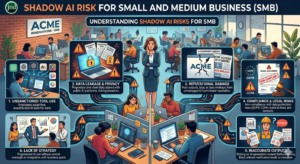
Shadow AI: The Hidden Cybersecurity Risk Financial Services Firms Can’t Ignore
Artificial Intelligence is rapidly transforming the financial services industry.
From automating workflows and improving client communication to accelerating underwriting and data analysis, AI is becoming embedded into daily operations across:
- Financial Advisors & RIAs
- Insurance Agencies
- Carriers
- BGAs & Distribution Firms
- FinTech & InsurTech Companies
- Accounting & Professional Services Firms
But while AI is driving innovation and productivity, it’s also introducing a growing cybersecurity and compliance challenge many organizations are not prepared for:
Shadow AI
Shadow AI refers to employees using AI tools, applications, or integrations without approval or oversight from IT, cybersecurity, or compliance teams.
This often happens when employees use public AI platforms to:
- summarize documents
- draft emails
- generate reports
- analyze spreadsheets
- write code
- automate workflows
While the intent is usually productivity, the risk comes from how sensitive business data is being shared and processed.
In many cases, organizations have little to no visibility into:
- what data is being uploaded
- where that data is stored
- who has access to it
- how it is retained
- whether it is compliant with industry regulations
Why Financial Services Firms Are Especially Vulnerable
Financial services organizations manage some of the most sensitive and regulated data in the world.
This includes:
- Personally Identifiable Information (PII)
- Financial records
- Investment strategies
- Insurance policyholder data
- Claims information
- Client communications
- Internal underwriting models
- Proprietary business processes
When this data is entered into unapproved AI tools, organizations may unintentionally expose themselves to:
- Data breaches
- Compliance violations
- Reputational damage
- Regulatory penalties
- Client trust issues
- Cyber insurance complications
For industries governed by:
- SEC regulations
- FINRA
- GLBA
- SOC 2
- HIPAA
- State privacy laws
Shadow AI can quickly become a major operational risk.
The Real Risk Isn’t AI — It’s Lack of Governance
AI itself is not the problem.
The real issue is organizations adopting AI faster than they establish security policies, governance, and oversight.
Most businesses already have employees using AI tools daily — often without leadership realizing how widespread it has become.
Common examples include:
- Uploading client spreadsheets into public AI chatbots
- Using AI meeting transcription tools without approval
- Connecting AI plugins to Microsoft 365 or Google Workspace
- Developers using AI coding assistants with proprietary code
- Employees using personal AI accounts for business work
These actions may bypass:
- security monitoring
- compliance controls
- audit logging
- retention policies
- data loss prevention systems
How Cybercriminals Are Leveraging AI
Shadow AI is only one side of the problem.
Attackers are also using AI to:
- create highly convincing phishing emails
- automate social engineering attacks
- generate malware variations
- scan for vulnerabilities faster
- impersonate executives using deepfake audio and video
This is dramatically increasing the speed and sophistication of cyberattacks targeting SMBs and financial firms.
Cybercriminals no longer need advanced technical skills to launch effective attacks.
AI is lowering the barrier to entry.
What Financial Services Firms Need To Do Now
1. Establish an AI Governance Policy
Organizations should clearly define:
- approved AI tools
- prohibited data types
- acceptable AI use cases
- retention requirements
- employee responsibilities
- security review processes
Employees should never be left guessing what is acceptable.
2. Implement Secure AI Solutions
Instead of banning AI entirely, firms should provide secure and approved alternatives with enterprise controls.
This may include:
- Microsoft Copilot for Microsoft 365
- Private AI environments
- Azure OpenAI deployments
- Enterprise AI platforms with logging and compliance protections
The goal is controlled innovation — not restricting productivity.
3. Strengthen Identity & Access Security
Many AI-related breaches originate from weak access controls.
Financial services firms should implement:
- Multi-Factor Authentication (MFA)
- Conditional Access Policies
- Least Privilege Access
- Identity Monitoring
- Single Sign-On (SSO)
- OAuth Application Reviews
Identity security is now one of the most critical layers of defense.
4. Monitor for Shadow AI Activity
Organizations should gain visibility into:
- AI-related web traffic
- unauthorized SaaS applications
- browser extensions
- data uploads
- third-party integrations
Modern cybersecurity platforms can help identify risky AI usage before it becomes a breach.
5. Train Employees on AI Risks
Most Shadow AI activity is not malicious — it’s convenience-driven.
Employee training should include:
- approved AI usage
- data handling policies
- phishing awareness
- AI hallucination risks
- compliance implications
- secure prompting practices
Security awareness training is now essential in the AI era.
6. Modernize Cybersecurity Programs
Financial firms should evaluate whether their current security posture is prepared for AI-driven threats.
This includes:
- Endpoint Detection & Response (EDR)
- Vulnerability Management
- Managed SOC Monitoring
- Secure Cloud Architecture
- Data Loss Prevention (DLP)
- Backup & Disaster Recovery
- Penetration Testing
- Compliance Readiness Assessments
AI has changed the threat landscape — security programs must evolve with it.
How JND Consulting Group Helps Financial Services Firms Secure Their Business
At JND Consulting Group, we help financial services organizations securely embrace innovation while reducing operational and cybersecurity risk.
Our team works with:
- InsurTech Companies
- RIAs
- Insurance Agencies
- BGAs
- Distribution Organizations
- SMBs
- Professional Services Firms
to deliver:
- AI Governance & Security Strategies
- Microsoft 365 & Azure Security Hardening
- Managed Cybersecurity Services
- Compliance Readiness
- Secure Cloud Architecture
- Endpoint Security & Monitoring
- Vulnerability Management
- Employee Security Awareness Training
- Custom Development & Secure Integrations
AI is here to stay.
The organizations that succeed will be the ones that balance innovation with security, governance, and operational discipline.