
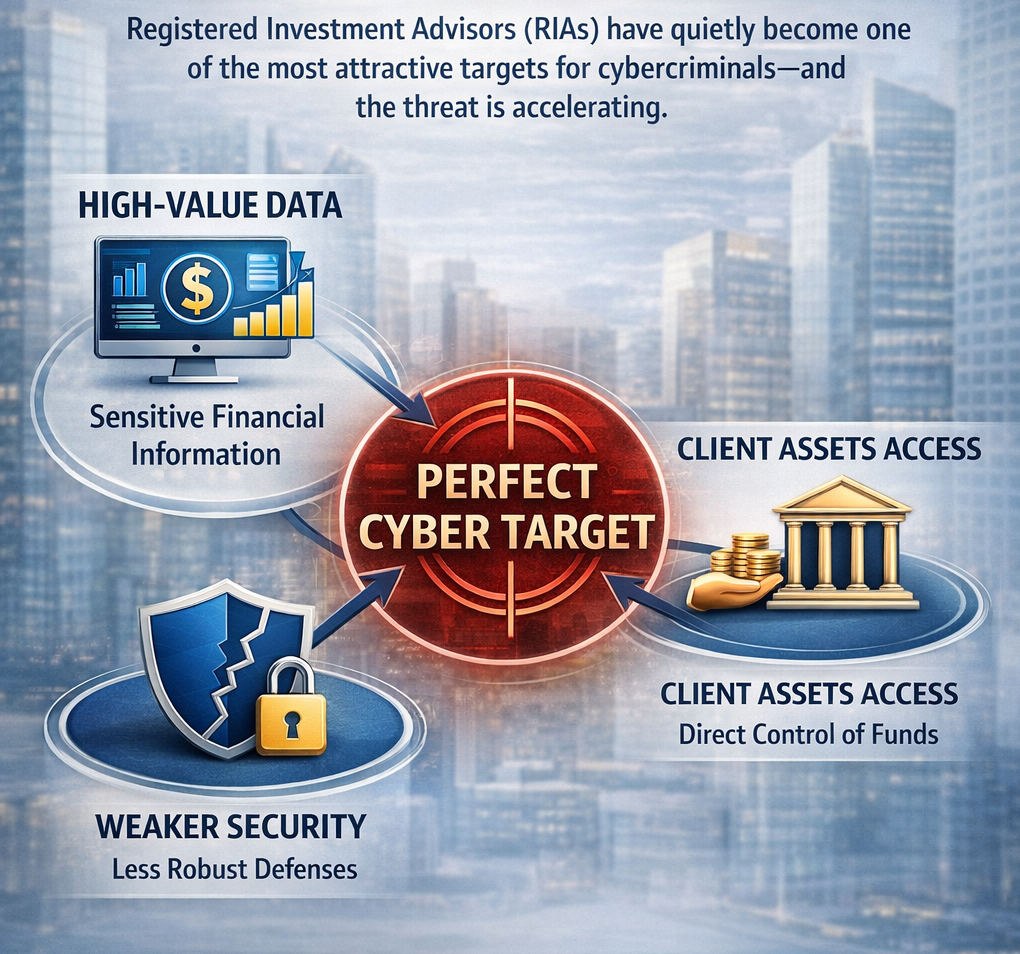
Registered Investment Advisors (RIAs) have quietly become one of the most attractive targets for cybercriminals—and the threat is accelerating. While large financial institutions have hardened their defenses, attackers are shifting toward RIAs because they sit at the intersection of high‑value financial data, direct access to client assets, and historically weaker cybersecurity controls.
This blog breaks down why RIAs are being targeted, how attackers are breaching firms, and what steps every advisory practice must take now to stay ahead of the threat.
 Why RIAs Are in the Crosshairs
1. RIAs Hold High‑Value, Monetizable Data
RIAs manage sensitive client information—banking details, investment accounts, retirement plans, tax data, and identity documents. This data is worth a premium on the dark web and can be used for:
- Wire fraud
- Identity theft
- Account takeover
- Social engineering of high‑net‑worth clients
Attackers know RIAs often have direct communication channels with wealthy individuals—making them ideal for impersonation and fraud.
2. Smaller Teams = Weaker Cyber Defenses
Unlike large broker‑dealers or banks, most RIAs operate with:
- Lean IT teams
- Limited cybersecurity budgets
- Outsourced or fragmented technology stacks
This creates gaps in:
- Patch management
- Endpoint protection
- Vendor oversight
- Incident response
Cybercriminals actively scan for these weaknesses.
3. Attackers Exploit Vendor & SaaS Dependencies
RIAs rely heavily on third‑party platforms:
• Portfolio management tools
• CRM systems
• Trading platforms
• Cloud storage
• Email and communication tools
This makes RIAs vulnerable to supply‑chain attacks, one of the fastest‑growing threats in 2025. Attackers compromise a vendor, then pivot into every RIA connected to that system.
4. Ransomware Groups Are Targeting Financial Services
Ransomware was involved in 44% of all breaches in 2025, according to industry reporting.
Financial firms—including RIAs—are especially attractive because:
- They cannot afford downtime
- They must maintain client trust
- They often pay quickly to restore operations
Attackers know this and tailor their extortion tactics accordingly.
5. Nation‑State Actors Are Increasingly Targeting U.S. Financial Infrastructure
Recent intelligence reports show nation‑state groups (China, North Korea, Iran) expanding their focus to smaller financial entities. These groups use:
• Credential‑harvesting malware
• Zero‑day exploits
• Supply‑chain infiltration
• AI‑powered phishing
The Microsoft Digital Defense Report highlights the scale of these threats, noting 100 trillion security signals processed daily and a surge in identity‑based attacks.
 How Attackers Are Breaching RIA
1. Business Email Compromise (BEC)
Attackers impersonate advisors or clients to initiate fraudulent wire transfers.
These emails are now AI‑generated—making them nearly indistinguishable from legitimate communication.
2. Credential Theft & MFA Fatigue
RIAs using cloud‑based systems are especially vulnerable to:
• Password reuse
• Weak MFA
• Push‑bombing attacks
Once inside, attackers move laterally into custodial or CRM systems.
3. Exploiting Unpatched Systems
Many RIAs rely on outdated:
• Firewalls
• Remote access tools
• Legacy servers
Attackers scan for these vulnerabilities 24/7.
4. Compromised Vendors
A single compromised SaaS provider can expose hundreds of RIAs simultaneously.
This trend mirrors the broader rise in software supply‑chain attacks seen across 2025.
🛑 The Real‑World Impact on RIAs
When an RIA is breached, the consequences are severe:
- Regulatory penalties (SEC, state regulators, FINRA for hybrid firms)
- Client loss and reputational damage
- Operational shutdowns
- Costly forensic investigations
- Mandatory breach notifications
The global average cost of a data breach in 2025 is $4.44 million, with U.S. breaches averaging $10.22 million.
For many RIAs, a single incident can be existential.
🛡️ What RIAs Must Do Now
1. Harden Email Security
- Enforce MFA
- Deploy advanced phishing protection
- Implement DMARC, DKIM, SPF
- Train staff on modern AI‑powered phishing tactics
2. Strengthen Vendor Risk Management
- Review SOC 2 reports
- Require cybersecurity attestations
- Monitor vendor access and permissions
- Build a vendor‑incident response plan
3. Implement Zero‑Trust Principles
- Least‑privilege access
- Continuous authentication
- Network segmentation
4. Patch Faster
Attackers exploit unpatched systems within hours.
Automated patching is no longer optional.
5. Build an Incident Response Plan
Every RIA should have:
- A documented IR plan
- A breach communication strategy
- A relationship with a cybersecurity firm
- Cyber insurance aligned with real risks
RIAs are no longer “too small” to be targeted. In fact, they’ve become one of the most attractive targets in the financial sector. Attackers know RIAs hold valuable data, rely on multiple vendors, and often lack enterprise‑grade defenses.
The firms that will thrive in 2026 are the ones that treat cybersecurity as a core business function, not a compliance checkbox.
Why RIAs Are Now Prime Targets for Cyberattacks in 2025–2026
Facebook Twitter LinkedIn Registered Investment Advisors (RIAs) have quietly become one of the most attractive targets for cybercriminals—and the threat is accelerating. While large financial
Is Your Cloud Data Truly Safe? Why Microsoft 365 and Google Workspace Need Third-Party Backup
Facebook Twitter LinkedIn Is Your Cloud Data Truly Safe? Why Microsoft 365 and Google Workspace Need Third-Party Backup In today’s cloud-first world, most businesses rely

February 2026: Six Actively Exploited Zero‑Days — An Unprecedented Warning for the Industry
Facebook Twitter LinkedIn February 2026: Six Actively Exploited Zero‑Days — An Unprecedented Warning for the Industry Microsoft February 2026 Patch Tuesday just landed, and it’s